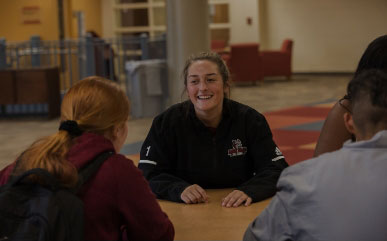
Last semester, Psychology major and Women’s Basketball team captain Arianna Gonzalez took on an ambitious challenge: a guidance counselor internship at her alma mater, South High School in Worcester. Juggling early morning shifts at the school, afternoon classes at Anna Maria, and basketball commitments made for some of the longest days of her college career, but the experience confirmed her career aspirations and taught her invaluable lessons about time management, professional development, and the power of coming full circle. In this Q&A, she reflects on what it was like to return to her former high school as a staff member, how she connected with students navigating the same challenges she faces as a student-athlete, and what she learned about the realities of working in a guidance office.
Q: What made this internship opportunity meaningful to you personally?
A: The chance to build connections with both staff and students at South High School was incredibly meaningful. Having graduated from there myself, coming back in a professional capacity created some powerful full-circle moments. I was especially moved the first time a student called me “Ms. Gonzalez” in the hallway. That really caught me off guard in the best way possible.
Q: What were your main responsibilities in the guidance department?
A: The guidance office doesn’t operate on a fixed schedule like classroom teachers do. Each day is shaped by student needs, meetings, and incoming requests. My consistent responsibilities included organizing and alphabetically sorting student transcripts and creating passes for field trips and college visits. I also participated in weekly attendance meetings with department supervisors where we discussed strategies to improve student attendance and recognize students who were doing well.
Q: Walk us through a typical day. What did your schedule look like?
A: I arrived at South High around 7:00 a.m. and spent the first 10-15 minutes connecting with the guidance counselors before students arrived. Once the bell rang, I’d work alongside my supervisor, who heads the guidance department, as she managed emails and responded to whatever the day brought. Around 10:30, the counselors would order lunch from the culinary program there, and then I’d head back to Anna Maria for my noon class. Those were long days. I had my internship from 7-11, class at 12, then film and practice in the afternoon, but I learned to build in time for myself, even if just 10 minutes, which made me more productive overall.
Q: What surprised you most about working in a high school guidance office?
A: I thought I knew what to expect since I’d attended South High, but I discovered aspects of the system I’d never seen as a student. During attendance meetings, I learned about district-wide policies I hadn’t known existed, like mandatory removal thresholds when students reach certain absence levels. These behind-the-scenes operations gave me a much deeper appreciation for the work guidance counselors do.
Q: How did your experience as basketball team captain inform your work with students?
A: Being captain has taught me a lot about time management and setting an example both on and off the court. When students asked me about balancing academics and athletics, I could speak from current experience. I’m honest with them that it’s hard and that it requires trial and error. I learned to map out my free blocks at the start of each semester and schedule everything: homework time, personal time, and extra gym sessions. The key is patience and consistency. You’ll make mistakes, but you learn and adjust.
Q: Did you find yourself connecting with student-athletes in particular?
A: Definitely. Students would come to me specifically to ask about managing sports and school because they could see I was living it. I tell them it all starts with time management in high school. That means being consistent in the classroom, participating, and completing work on time. Those habits are what prepared me to be captain. It’s an honor to lead my team, and I wouldn’t trade this position for anything, but it’s also taught me that being in a leadership role means you’re setting the tone in everything you do.
Q: What parallels did you notice between leading on the court and helping guide students?
A: Both require building trust. With my team, I had to earn their confidence on and off the court. In the guidance office, I noticed students were initially hesitant around me as a new face. But as they came in more often, they became comfortable opening up to me. That process of building trust and creating a safe space is fundamental to both roles.
Q: How did your Anna Maria coursework prepare you for this experience?
A: The general psychology courses gave me a deeper understanding of the factors involved in guidance counseling. While no single course directly mapped to the internship, that foundational knowledge helped me better understand student challenges and the counseling process.
Q: What skills did you develop or strengthen?
A: Time management was huge. Learning when to leave for South, when to wake up, and how to fit everything into packed days. I also developed my professional presence, particularly in group settings during staff meetings. And I learned the importance of self-care. When I started prioritizing even 10 minutes for myself, I became more productive and less overwhelmed.
Q: Did this experience confirm your career aspirations?
A: Absolutely. I’ve known since graduation that I wanted to work with students in schools, but it wasn’t until the end of my freshman year that I seriously considered becoming a guidance counselor. I’m lucky to have a family friend who’s a counselor at South. I reached out about internship possibilities, and a year later, here I was. Seeing what the job actually looks like day-to-day made me genuinely excited about my future.
Q: What would you tell current high school students about their guidance resources?
A: Use them while you have them. Your guidance counselor is there for everything – bad days, good news, questions about classes or college, or just someone to talk to. Once you graduate, you won’t have that built-in support person who already knows you. After high school, you’ll find new mentors like professors, coworkers, and family members, but it takes time to build those trusting relationships. Take advantage of the counselor you’ve known for four years.
Q: What advice would you give Anna Maria students considering similar internships?
A: Don’t be afraid to make the first move. I brought this opportunity to my advisor, and she was immediately supportive. Also, don’t hesitate to try internships in different settings to figure out what you like. I shadowed an elementary adjustment counselor in Paxton and realized that path wasn’t for me, but I wouldn’t have known without trying. For student-athletes, don’t worry about scheduling conflicts. Your advisor will work with you to ensure the internship fits around practices and games.
Q: Looking back, what was your most valuable takeaway?
A: I discovered a new version of myself. This internship helped me mature and start thinking seriously about my future in a way I hadn’t before. That shift in perspective from thinking about my future in spurts to actively planning for it has been transformative.